

Paper Abstract
- ARR: Question Answering with Large Language Models via Analyzing, Retrieving, and Reasoning
- Authors: Yuwei Yin and Giuseppe Carenini
- Paper: https://huggingface.co/papers/2502.04689
Large language models (LLMs) have demonstrated impressive capabilities on complex
evaluation benchmarks, many of which are formulated as question-answering (QA) tasks.
Enhancing the performance of LLMs in QA contexts is becoming increasingly vital for
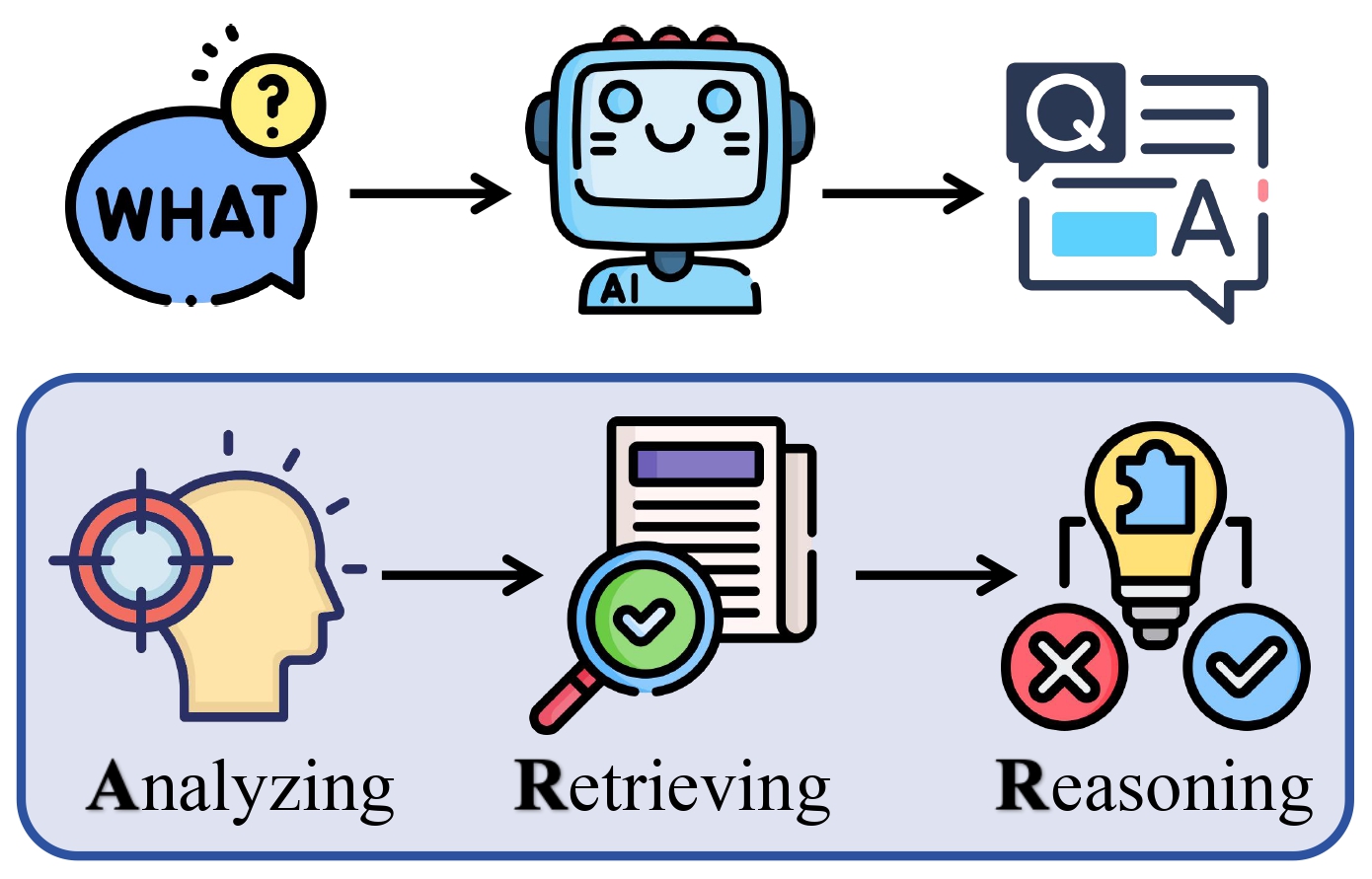
advancing their development and applicability. This paper introduces ARR, an intuitive,
effective, and general QA solving method that explicitly incorporates three key steps:
analyzing the intent of the question, retrieving relevant information, and reasoning
step by step. Notably, this paper is the first to introduce intent analysis in QA,
which plays a vital role in ARR. Comprehensive evaluations across 10 diverse QA tasks
demonstrate that ARR consistently outperforms the baseline methods. Ablation and case
studies further validate the positive contributions of each ARR component. Furthermore,
experiments involving variations in prompt design indicate that ARR maintains its
effectiveness regardless of the specific prompt formulation. Additionally, extensive
evaluations across various model sizes, LLM series, and generation settings solidify
the effectiveness, robustness, and generalizability of ARR.
Environment Setup
- Python: Python 3.10
- GPU: A single NVIDIA V100-32GB or A100-40GB GPU
- 1B/3B/7B/8B LLMs
float16inference mode only
- 1B/3B/7B/8B LLMs
git clone https://github.com/YuweiYin/ARR
cd ARR/
# Now, "/path/to/ARR/" is the project root directory

# https://docs.conda.io/projects/miniconda/en/latest/
conda create -n arr python=3.10 -y
conda activate arr

pip install -r requirements.txt -i https://pypi.org/simple/
pip install -e . -i https://pypi.org/simple/

# We can set the Hugging Face cache directory. The following is for the dataset cache.
export HF_HOME="/path/to/your/.cache/huggingface/datasets" # Default: "${HOME}/.cache/huggingface/datasets/"- Download the datasets and models beforehand if the computing nodes have no Internet access or HOME storage is limited.
- Please ensure
CACHE_DIRandHF_TOKENin the script are correct directories.
# https://huggingface.co/datasets
HF_TOKEN="YOUR_HF_TOKEN"  # https://huggingface.co/settings/tokens
CACHE_DIR="YOUR_HF_CACHE_DIR"  # E.g., "${HOME}/.cache/huggingface/"
bash run_download_datasets.sh "${HF_TOKEN}" "${CACHE_DIR}"  # Download data to "${CACHE_DIR}/datasets/"
Multi Choice QA Datasets
- Reading Comprehension
- Commonsense Reasoning
- World Knowledge
- Multitask Understanding
-
bbh: BigBench Hard (BBH) - BigBench Paper; BigBench GitHub; BBH Paper; BBH Dataset -
mmlu: MMLU - Paper; Dataset; No-Train Data -
mmlu_pro: MMLU-Pro - Paper; Dataset
-
# https://huggingface.co/models
HF_TOKEN="YOUR_HF_TOKEN"  # https://huggingface.co/settings/tokens
CACHE_DIR="YOUR_HF_CACHE_DIR"  # E.g., "${HOME}/.cache/huggingface/"
bash run_download_models.sh "${HF_TOKEN}" "${CACHE_DIR}" # Download models to "${CACHE_DIR}/"For each bash script, please ensure CACHE_DIR and PROJECT_DIR in the script are
correct Hugging Face cache directory (default: "~/.cache/huggingface/") and
project root directory ("/path/to/ARR/").
mkdir -p logs/  # where we save running logs
mkdir -p results/ # where we save experimental resultsExperimental Settings
- Comparison: (Zero-shot Settings)
- w/o Reason: directly selecting options without relying on rationales (skipping Reasoning Generation)
- DA (Direct Answer):
"Answer:" - CoT (Chain-of-Thought):
"Answer: Let's think step by step." - ARR:
"Answer: Let's analyze the intent of the question, find relevant information, and answer the question with step-by-step reasoning."
- Models:
-
meta-llama/Llama-3.1-8B-Instruct(Link)
-
Experiment Script
CACHE_DIR="YOUR_HF_CACHE_DIR"  # E.g., "${HOME}/.cache/huggingface/"
PROJECT_DIR="/path/to/ARR/"

MODEL="meta-llama/Llama-3.1-8B-Instruct"
NUM_FEWSHOT="0"

# [Reasoning Generation] **First**, freely generate answer with reasoning/rationale:
echo -e "\n\n >>> bash run_gen_lm.sh --hf_id ${MODEL} QA_ALL ${NUM_FEWSHOT}-shot"
bash run_gen_lm.sh "1;${MODEL};1;QA_ALL;0.0;${NUM_FEWSHOT}" "${CACHE_DIR}" "${PROJECT_DIR}"
echo -e "\n\n >>> bash run_gen_lm-cot.sh --hf_id ${MODEL} QA_ALL ${NUM_FEWSHOT}-shot"
bash run_gen_lm-cot.sh "1;${MODEL};1;QA_ALL;0.0;${NUM_FEWSHOT}" "${CACHE_DIR}" "${PROJECT_DIR}"
echo -e "\n\n >>> bash run_gen_lm-arr.sh --hf_id ${MODEL} QA_ALL ${NUM_FEWSHOT}-shot"
bash run_gen_lm-arr.sh "1;${MODEL};1;QA_ALL;0.0;${NUM_FEWSHOT}" "${CACHE_DIR}" "${PROJECT_DIR}"

# [Option Selection] **Second**, answer the question (evaluate each option) (multi-choice QA -- Accuracy):
echo -e "\n\n >>> bash run_eval_lm-no_gen.sh --hf_id ${MODEL} QA_ALL ${NUM_FEWSHOT}-shot"  # w/o Reason
bash run_eval_lm-no_gen.sh "1;${MODEL};1;QA_ALL;0.0;${NUM_FEWSHOT}" "${CACHE_DIR}" "${PROJECT_DIR}"
echo -e "\n\n >>> bash run_eval_lm.sh --hf_id ${MODEL} QA_ALL ${NUM_FEWSHOT}-shot"  # DA
bash run_eval_lm.sh "1;${MODEL};1;QA_ALL;0.0;${NUM_FEWSHOT}" "${CACHE_DIR}" "${PROJECT_DIR}"
echo -e "\n\n >>> bash run_eval_lm-cot.sh --hf_id ${MODEL} QA_ALL ${NUM_FEWSHOT}-shot"  # CoT
bash run_eval_lm-cot.sh "1;${MODEL};1;QA_ALL;0.0;${NUM_FEWSHOT}" "${CACHE_DIR}" "${PROJECT_DIR}"
echo -e "\n\n >>> bash run_eval_lm-arr.sh --hf_id ${MODEL} QA_ALL ${NUM_FEWSHOT}-shot"  # ARR
bash run_eval_lm-arr.sh "1;${MODEL};1;QA_ALL;0.0;${NUM_FEWSHOT}" "${CACHE_DIR}" "${PROJECT_DIR}"Experimental Settings
- Comparison:
- A / R / R: Analyzing / Retrieving / Reasoning
- ARR = "000" "001" "010" "100" "111"
- ARR 000 = DA:
"Answer:" - ARR 001 = Reasoning-only:
"Answer: Let's answer the question with step-by-step reasoning." - ARR 010 = Retrieving-only:
"Answer: Let's find relevant information, and answer the question." - ARR 100 = Analyzing-only:
"Answer: Let's analyze the intent of the question, and answer the question." - ARR 111 = ARR:
"Answer: Let's analyze the intent of the question, find relevant information, and answer the question with step-by-step reasoning."
- Models:
-
meta-llama/Llama-3.1-8B-Instruct(Link)
-
Experiment Script
CACHE_DIR="YOUR_HF_CACHE_DIR"  # E.g., "${HOME}/.cache/huggingface/"
PROJECT_DIR="/path/to/ARR/"

MODEL="meta-llama/Llama-3.1-8B-Instruct"
NUM_FEWSHOT="0"

# [Reasoning Generation] **First**, freely generate answer with reasoning/rationale:
for ABLATION in "001" "010" "100"  # "000" = DA; "111" = ARR
do
  echo -e "\n\n >>> bash run_gen_lm-arr.sh --hf_id ${MODEL} QA_ALL ${NUM_FEWSHOT}-shot (ABLATION: ARR = ${ABLATION})"
  bash run_gen_lm-arr.sh "1;${MODEL};1;QA_ALL;0.0;${NUM_FEWSHOT};${ABLATION}" "${CACHE_DIR}" "${PROJECT_DIR}"
done

# [Option Selection] **Second**, answer the question (evaluate each option) (multi-choice QA -- Accuracy):
for ABLATION in "001" "010" "100"  # "000" = DA; "111" = ARR
do
  echo -e "\n\n >>> bash run_eval_lm-arr.sh --hf_id ${MODEL} QA_ALL ${NUM_FEWSHOT}-shot (ABLATION: ARR = ${ABLATION})"
  bash run_eval_lm-arr.sh "1;${MODEL};1;QA_ALL;0.0;${NUM_FEWSHOT};${ABLATION}" "${CACHE_DIR}" "${PROJECT_DIR}"
doneExperimental Settings
- Comparison:
- Ask GPT-4o to paraphrase the original ARR prompt:
- "Paraphrase the following prompt (into 5 different versions) while keeping the three steps (intent analysis, information retrieval, and step-by-step reasoning): Let's analyze the intent of the question, find relevant information, and answer the question with step-by-step reasoning."
"var1": Let's identify the question's intent, gather the necessary information, and then work through a logical, step-by-step solution."var2": We'll begin by examining what the question is asking, then retrieve any relevant details, and finally provide a well-reasoned answer step by step."var3": First, we'll interpret the purpose behind the question, collect supporting information, and proceed to solve it methodically."var4": Let's break this down by understanding the goal of the question, pulling in the required data, and then reasoning through the answer in a clear sequence."var5": To approach this, we'll clarify the question's intent, locate pertinent information, and then build our answer using structured, logical reasoning.
- Ask GPT-4o to paraphrase the original ARR prompt:
- Models:
-
meta-llama/Llama-3.1-8B-Instruct(Link)
-
Experiment Script
CACHE_DIR="YOUR_HF_CACHE_DIR"  # E.g., "${HOME}/.cache/huggingface/"
PROJECT_DIR="/path/to/ARR/"

MODEL="meta-llama/Llama-3.1-8B-Instruct"
NUM_FEWSHOT="0"

# **First**, freely generate answer with reasoning/rationale:
for VARIANT in "var1" "var2" "var3" "var4" "var5"
do
  echo -e "\n\n >>> bash run_gen_lm-arr.sh --hf_id ${MODEL} QA_ALL ${NUM_FEWSHOT}-shot (PROMPT VARIANT = ${VARIANT})"
  bash run_gen_lm-arr.sh "1;${MODEL};1;QA_ALL;0.0;${NUM_FEWSHOT};${VARIANT}" "${CACHE_DIR}" "${PROJECT_DIR}"
done

# **Second**, evaluate the generated content (multi-choice QA -- Accuracy):
for VARIANT in "var1" "var2" "var3" "var4" "var5"
do
  echo -e "\n\n >>> bash run_eval_lm-arr.sh --hf_id ${MODEL} QA_ALL ${NUM_FEWSHOT}-shot (PROMPT VARIANT = ${VARIANT})"
  bash run_eval_lm-arr.sh "1;${MODEL};1;QA_ALL;0.0;${NUM_FEWSHOT};${VARIANT}" "${CACHE_DIR}" "${PROJECT_DIR}"
doneExperimental Settings
Experiment Script
CACHE_DIR="YOUR_HF_CACHE_DIR"  # E.g., "${HOME}/.cache/huggingface/"
PROJECT_DIR="/path/to/ARR/"

# [Reasoning Generation] **First**, freely generate answer with reasoning/rationale:
for MODEL in "meta-llama/Llama-3.2-1B-Instruct" "meta-llama/Llama-3.2-3B-Instruct"
do
  NUM_FEWSHOT="0"
  echo -e "\n\n >>> bash run_gen_lm.sh --hf_id ${MODEL} QA_GEN ${NUM_FEWSHOT}-shot"
  bash run_gen_lm.sh "1;${MODEL};1;QA_GEN;0.0;${NUM_FEWSHOT}" "${CACHE_DIR}" "${PROJECT_DIR}"
  echo -e "\n\n >>> bash run_gen_lm-cot.sh --hf_id ${MODEL} QA_GEN ${NUM_FEWSHOT}-shot"
  bash run_gen_lm-cot.sh "1;${MODEL};1;QA_GEN;0.0;${NUM_FEWSHOT}" "${CACHE_DIR}" "${PROJECT_DIR}"
  echo -e "\n\n >>> bash run_gen_lm-arr.sh --hf_id ${MODEL} QA_GEN ${NUM_FEWSHOT}-shot"
  bash run_gen_lm-arr.sh "1;${MODEL};1;QA_GEN;0.0;${NUM_FEWSHOT}" "${CACHE_DIR}" "${PROJECT_DIR}"
done

# [Option Selection] **Second**, answer the question (evaluate each option) (multi-choice QA -- Accuracy):
for MODEL in "meta-llama/Llama-3.2-1B-Instruct" "meta-llama/Llama-3.2-3B-Instruct"
do
  NUM_FEWSHOT="0"
  echo -e "\n\n >>> bash run_eval_lm.sh --hf_id ${MODEL} QA_GEN ${NUM_FEWSHOT}-shot"
  bash run_eval_lm.sh "1;${MODEL};1;QA_GEN;0.0;${NUM_FEWSHOT}" "${CACHE_DIR}" "${PROJECT_DIR}"
  echo -e "\n\n >>> bash run_eval_lm-cot.sh --hf_id ${MODEL} QA_GEN ${NUM_FEWSHOT}-shot"
  bash run_eval_lm-cot.sh "1;${MODEL};1;QA_GEN;0.0;${NUM_FEWSHOT}" "${CACHE_DIR}" "${PROJECT_DIR}"
  echo -e "\n\n >>> bash run_eval_lm-arr.sh --hf_id ${MODEL} QA_GEN ${NUM_FEWSHOT}-shot"
  bash run_eval_lm-arr.sh "1;${MODEL};1;QA_GEN;0.0;${NUM_FEWSHOT}" "${CACHE_DIR}" "${PROJECT_DIR}"
doneExperimental Settings
Experiment Script
CACHE_DIR="YOUR_HF_CACHE_DIR"  # E.g., "${HOME}/.cache/huggingface/"
PROJECT_DIR="/path/to/ARR/"

# [Reasoning Generation] **First**, freely generate answer with reasoning/rationale:
for MODEL in "Qwen/Qwen2.5-7B-Instruct" "google/gemma-7b-it" "mistralai/Mistral-7B-Instruct-v0.3"
do
  NUM_FEWSHOT="0"
  echo -e "\n\n >>> bash run_gen_lm.sh --hf_id ${MODEL} QA_GEN ${NUM_FEWSHOT}-shot"
  bash run_gen_lm.sh "1;${MODEL};1;QA_GEN;0.0;${NUM_FEWSHOT}" "${CACHE_DIR}" "${PROJECT_DIR}"
  echo -e "\n\n >>> bash run_gen_lm-cot.sh --hf_id ${MODEL} QA_GEN ${NUM_FEWSHOT}-shot"
  bash run_gen_lm-cot.sh "1;${MODEL};1;QA_GEN;0.0;${NUM_FEWSHOT}" "${CACHE_DIR}" "${PROJECT_DIR}"
  echo -e "\n\n >>> bash run_gen_lm-arr.sh --hf_id ${MODEL} QA_GEN ${NUM_FEWSHOT}-shot"
  bash run_gen_lm-arr.sh "1;${MODEL};1;QA_GEN;0.0;${NUM_FEWSHOT}" "${CACHE_DIR}" "${PROJECT_DIR}"
done

# [Option Selection] **Second**, answer the question (evaluate each option) (multi-choice QA -- Accuracy):
for MODEL in "Qwen/Qwen2.5-7B-Instruct" "google/gemma-7b-it" "mistralai/Mistral-7B-Instruct-v0.3"
do
  NUM_FEWSHOT="0"
  echo -e "\n\n >>> bash run_eval_lm.sh --hf_id ${MODEL} QA_GEN ${NUM_FEWSHOT}-shot"
  bash run_eval_lm.sh "1;${MODEL};1;QA_GEN;0.0;${NUM_FEWSHOT}" "${CACHE_DIR}" "${PROJECT_DIR}"
  echo -e "\n\n >>> bash run_eval_lm-cot.sh --hf_id ${MODEL} QA_GEN ${NUM_FEWSHOT}-shot"
  bash run_eval_lm-cot.sh "1;${MODEL};1;QA_GEN;0.0;${NUM_FEWSHOT}" "${CACHE_DIR}" "${PROJECT_DIR}"
  echo -e "\n\n >>> bash run_eval_lm-arr.sh --hf_id ${MODEL} QA_GEN ${NUM_FEWSHOT}-shot"
  bash run_eval_lm-arr.sh "1;${MODEL};1;QA_GEN;0.0;${NUM_FEWSHOT}" "${CACHE_DIR}" "${PROJECT_DIR}"
doneExperimental Settings
- Comparison:
- The effect of the proposed ARR method using proprietary LLMs
- Models:
-
gpt-4o(OpenAI GPT-4o)
-
Experiment Script
CACHE_DIR="YOUR_HF_CACHE_DIR"  # E.g., "${HOME}/.cache/huggingface/"
PROJECT_DIR="/path/to/ARR/"
OPENAI_KEY="YOUR_OPENAI_API_KEY"

# Method: DA; Dataset: OpenBookQA
python3 run_gen_gpt.py --verbose --task 2 --cache_dir "${CACHE_DIR}" --project_dir "${PROJECT_DIR}" \
  --output_dir "results/gen_lm-gpt4o_da/" --openai_model "gpt-4o" --openai_api_key "${OPENAI_KEY}" \
  --temperature "0.0" --api_call_sleep "3.0" --max_eval_num "-1" --eval_task_name "openbookqa"
python3 run_eval_gpt.py --verbose --task 1 --cache_dir "${CACHE_DIR}" --project_dir "${PROJECT_DIR}" \
  --output_dir "results/gen_lm-gpt4o_da/" --use_gen_output --overwrite --eval_task_name "openbookqa"

# Method: CoT; Dataset: OpenBookQA
python3 run_gen_gpt.py --verbose --task 2 --cache_dir "${CACHE_DIR}" --project_dir "${PROJECT_DIR}" \
  --output_dir "results/gen_lm-gpt4o_cot/" --openai_model "gpt-4o" --openai_api_key "${OPENAI_KEY}" \
  --temperature "0.0" --api_call_sleep "3.0" --max_eval_num "-1" --eval_task_name "openbookqa" \
  --use_cot
python3 run_eval_gpt.py --verbose --task 1 --cache_dir "${CACHE_DIR}" --project_dir "${PROJECT_DIR}" \
  --output_dir "results/gen_lm-gpt4o_cot/" --use_gen_output --overwrite --eval_task_name "openbookqa"

# Method: ARR; Dataset: OpenBookQA
python3 run_gen_gpt.py --verbose --task 2 --cache_dir "${CACHE_DIR}" --project_dir "${PROJECT_DIR}" \
  --output_dir "results/gen_lm-gpt4o_arr/" --openai_model "gpt-4o" --openai_api_key "${OPENAI_KEY}" \
  --temperature "0.0" --api_call_sleep "3.0" --max_eval_num "-1" --eval_task_name "openbookqa" \
  --use_arr --arr_ablation "111"
python3 run_eval_gpt.py --verbose --task 1 --cache_dir "${CACHE_DIR}" --project_dir "${PROJECT_DIR}" \
  --output_dir "results/gen_lm-gpt4o_arr/" --use_gen_output --overwrite --eval_task_name "openbookqa"

# Method: DA; Dataset: MMLU (subset: 10 instances per subtask)
python3 run_gen_gpt.py --verbose --task 2 --cache_dir "${CACHE_DIR}" --project_dir "${PROJECT_DIR}" \
  --output_dir "results/gen_lm-gpt4o_da/" --openai_model "gpt-4o" --openai_api_key "${OPENAI_KEY}" \
  --temperature "0.0" --api_call_sleep "3.0" --max_eval_num "10" --eval_task_name "mmlu"
python3 run_eval_gpt.py --verbose --task 1 --cache_dir "${CACHE_DIR}" --project_dir "${PROJECT_DIR}" \
  --output_dir "results/gen_lm-gpt4o_da/" --use_gen_output --overwrite --eval_task_name "mmlu"

# Method: CoT; Dataset: MMLU (subset: 10 instances per subtask)
python3 run_gen_gpt.py --verbose --task 2 --cache_dir "${CACHE_DIR}" --project_dir "${PROJECT_DIR}" \
  --output_dir "results/gen_lm-gpt4o_cot/" --openai_model "gpt-4o" --openai_api_key "${OPENAI_KEY}" \
  --temperature "0.0" --api_call_sleep "3.0" --max_eval_num "10" --eval_task_name "mmlu" \
  --use_cot
python3 run_eval_gpt.py --verbose --task 1 --cache_dir "${CACHE_DIR}" --project_dir "${PROJECT_DIR}" \
  --output_dir "results/gen_lm-gpt4o_cot/" --use_gen_output --overwrite --eval_task_name "mmlu"

# Method: ARR; Dataset: MMLU (subset: 10 instances per subtask)
python3 run_gen_gpt.py --verbose --task 2 --cache_dir "${CACHE_DIR}" --project_dir "${PROJECT_DIR}" \
  --output_dir "results/gen_lm-gpt4o_arr/" --openai_model "gpt-4o" --openai_api_key "${OPENAI_KEY}" \
  --temperature "0.0" --api_call_sleep "3.0" --max_eval_num "10" --eval_task_name "mmlu" \
  --use_arr --arr_ablation "111"
python3 run_eval_gpt.py --verbose --task 1 --cache_dir "${CACHE_DIR}" --project_dir "${PROJECT_DIR}" \
--output_dir "results/gen_lm-gpt4o_arr/" --use_gen_output --overwrite --eval_task_name "mmlu"Experimental Settings
- Comparison:
- Observe the effect of the proposed ARR method using different generation temperatures
- Temperature: 0 (default), 0.5, 1.0, 1.5
- Models:
-
meta-llama/Llama-3.1-8B-Instruct(Link)
-
Experiment Script
CACHE_DIR="YOUR_HF_CACHE_DIR"  # E.g., "${HOME}/.cache/huggingface/"
PROJECT_DIR="/path/to/ARR/"

MODEL="meta-llama/Llama-3.1-8B-Instruct"

# [Reasoning Generation] **First**, freely generate answer with reasoning/rationale:
NUM_FEWSHOT="0"
for TEMPERATURE in "0.5" "1.0" "1.5"  # default: "0.0"
do
  echo -e "\n\n >>> bash run_gen_lm.sh --hf_id ${MODEL} QA_GEN ${NUM_FEWSHOT}-shot"
  bash run_gen_lm.sh "1;${MODEL};1;QA_GEN;${TEMPERATURE};${NUM_FEWSHOT}" "${CACHE_DIR}" "${PROJECT_DIR}"
  echo -e "\n\n >>> bash run_gen_lm-cot.sh --hf_id ${MODEL} QA_GEN ${NUM_FEWSHOT}-shot"
  bash run_gen_lm-cot.sh "1;${MODEL};1;QA_GEN;${TEMPERATURE};${NUM_FEWSHOT}" "${CACHE_DIR}" "${PROJECT_DIR}"
  echo -e "\n\n >>> bash run_gen_lm-arr.sh --hf_id ${MODEL} QA_GEN ${NUM_FEWSHOT}-shot"
  bash run_gen_lm-arr.sh "1;${MODEL};1;QA_GEN;${TEMPERATURE};${NUM_FEWSHOT}" "${CACHE_DIR}" "${PROJECT_DIR}"
done

# [Option Selection] **Second**, answer the question (evaluate each option) (multi-choice QA -- Accuracy):
NUM_FEWSHOT="0"
for TEMPERATURE in "0.5" "1.0" "1.5"  # default: "0.0"
do
  echo -e "\n\n >>> bash run_eval_lm.sh --hf_id ${MODEL} QA_GEN ${NUM_FEWSHOT}-shot"
  bash run_eval_lm.sh "1;${MODEL};1;QA_GEN;${TEMPERATURE};${NUM_FEWSHOT}" "${CACHE_DIR}" "${PROJECT_DIR}"
  echo -e "\n\n >>> bash run_eval_lm-cot.sh --hf_id ${MODEL} QA_GEN ${NUM_FEWSHOT}-shot"
  bash run_eval_lm-cot.sh "1;${MODEL};1;QA_GEN;${TEMPERATURE};${NUM_FEWSHOT}" "${CACHE_DIR}" "${PROJECT_DIR}"
  echo -e "\n\n >>> bash run_eval_lm-arr.sh --hf_id ${MODEL} QA_GEN ${NUM_FEWSHOT}-shot"
  bash run_eval_lm-arr.sh "1;${MODEL};1;QA_GEN;${TEMPERATURE};${NUM_FEWSHOT}" "${CACHE_DIR}" "${PROJECT_DIR}"
doneExperimental Settings
- Comparison:
- Observe the effect of the proposed ARR method in few-shot settings (using different shots)
- QA Performance comparison among DA (in-context learning), few-shot CoT, and few-shot ARR methods
- N shots: 0 (default), 1, 3, and 5
- Models:
-
meta-llama/Llama-3.1-8B-Instruct(Link)
-
Obtain CoT/ARR Rationales for Few-shot Examples
# Before LLM generation and evaluation, we first obtain 1/3/5 few-shot examples from the dev/train set,
#   where the CoT and ARR reasoning/rationale for each few-shot example is constructed by GPT-4o.
# Now, the `few_shot.json` file under each evaluation task already has CoT and ARR reasoning/rationale.

#CACHE_DIR="YOUR_HF_CACHE_DIR"  # E.g., "${HOME}/.cache/huggingface/"
#PROJECT_DIR="/path/to/ARR/"
#bash run_gen_gpt.sh "1;QA_GEN;0;111;1.0" "${CACHE_DIR}" "${PROJECT_DIR
Experiment Script
CACHE_DIR="YOUR_HF_CACHE_DIR"  # E.g., "${HOME}/.cache/huggingface/"
PROJECT_DIR="/path/to/ARR/"

MODEL="meta-llama/Llama-3.1-8B-Instruct"

# [Reasoning Generation] **First**, freely generate answer with reasoning/rationale:
for NUM_FEWSHOT in "1" "3" "5"  # default: "0"
do
  echo -e "\n\n >>> bash run_gen_lm.sh --hf_id ${MODEL} QA_GEN ${NUM_FEWSHOT}-shot"
  bash run_gen_lm.sh "1;${MODEL};1;QA_GEN;0.0;${NUM_FEWSHOT}" "${CACHE_DIR}" "${PROJECT_DIR}"
  echo -e "\n\n >>> bash run_gen_lm-cot.sh --hf_id ${MODEL} QA_GEN ${NUM_FEWSHOT}-shot"
  bash run_gen_lm-cot.sh "1;${MODEL};1;QA_GEN;0.0;${NUM_FEWSHOT}" "${CACHE_DIR}" "${PROJECT_DIR}"
  echo -e "\n\n >>> bash run_gen_lm-arr.sh --hf_id ${MODEL} QA_GEN ${NUM_FEWSHOT}-shot"
  bash run_gen_lm-arr.sh "1;${MODEL};1;QA_GEN;0.0;${NUM_FEWSHOT}" "${CACHE_DIR}" "${PROJECT_DIR}"
done

# [Option Selection] **Second**, answer the question (evaluate each option) (multi-choice QA -- Accuracy):
for NUM_FEWSHOT in "1" "3" "5"  # default: "0"
do
  echo -e "\n\n >>> bash run_eval_lm.sh --hf_id ${MODEL} QA_GEN ${NUM_FEWSHOT}-shot"
  bash run_eval_lm.sh "1;${MODEL};1;QA_GEN;0.0;${NUM_FEWSHOT}" "${CACHE_DIR}" "${PROJECT_DIR}"
  echo -e "\n\n >>> bash run_eval_lm-cot.sh --hf_id ${MODEL} QA_GEN ${NUM_FEWSHOT}-shot"
  bash run_eval_lm-cot.sh "1;${MODEL};1;QA_GEN;0.0;${NUM_FEWSHOT}" "${CACHE_DIR}" "${PROJECT_DIR}"
  echo -e "\n\n >>> bash run_eval_lm-arr.sh --hf_id ${MODEL} QA_GEN ${NUM_FEWSHOT}-shot"
  bash run_eval_lm-arr.sh "1;${MODEL};1;QA_GEN;0.0;${NUM_FEWSHOT}" "${CACHE_DIR}" "${PROJECT_DIR}"
donePlease refer to the LICENSE file for more details.
- Paper (arXiv): https://arxiv.org/abs/2502.04689
- If you find our work helpful, please kindly star this GitHub repo and cite our paper. 🤗
@article{yin2025arr,
  title   = {ARR: Question Answering with Large Language Models via Analyzing, Retrieving, and Reasoning},
  author  = {Yin, Yuwei and Carenini, Giuseppe},
  journal = {arXiv preprint arXiv:2502.04689},
  year    = {2025},
  url     = {https://arxiv.org/abs/2502.04689},
}